Why a Jewellery Content Creation Tool Is Now Essential
In luxury retail, visuals do more than show a product—they transmit trust, rarity, and craftsmanship. Yet creating images that honor the nuanced sparkle of gemstones, the depth of precious metals, and the subtlety of pavé settings can be slow and expensive. A modern jewellery content creation tool changes that equation by transforming sketches, CAD files, or even quick product shots into consistent, polished assets suitable for e-commerce, social, and print—without the delays of traditional shoots.
What makes this approach transformative is how it bridges concept and commerce. Designers can preview finishes and stone variations before a prototype exists. Merchandisers can test collections across multiple backdrops, models, and lighting styles. Marketers can spin up seasonal visuals for campaigns in days rather than weeks. The result is creative agility, tighter collaboration across design and marketing, and dramatically improved time to market—crucial advantages when trend cycles and launch calendars move fast.
Jewellery is visually demanding: reflections, micro-facets, prongs, and bezels interact with light in complex ways. An effective platform uses AI-driven materials and lighting models to simulate realistic metal anisotropy, refractive indices for gems, soft and hard shadows, and natural reflections. This ensures that diamonds look crisp rather than flat, gold appears warm and dimensional rather than overly glossy, and intricate details survive compression for mobile feeds while still holding sharpness for high-resolution print.
The best solutions also address the realities of omnichannel selling. A single collection needs multiple outputs: clean packshots for product detail pages, lifestyle scenes for homepages, and on-model compositions for lookbooks. With an AI-powered studio, you can generate consistent 2K and 4K deliverables, maintain brand-safe lighting and color science, and switch formats—from square grids to portrait Stories—without resetting your entire workflow.
For independent boutiques or regional chains, local agility matters. Whether promoting a launch in London, Dubai, or New York, teams can adapt the same hero piece to local backdrops and editorial styles, keep language and cultural cues relevant, and still maintain a unified brand identity. That blend of global consistency and local nuance is why an intelligent, AI-first jewellery content creation tool is rapidly becoming the standard for modern luxury content production.
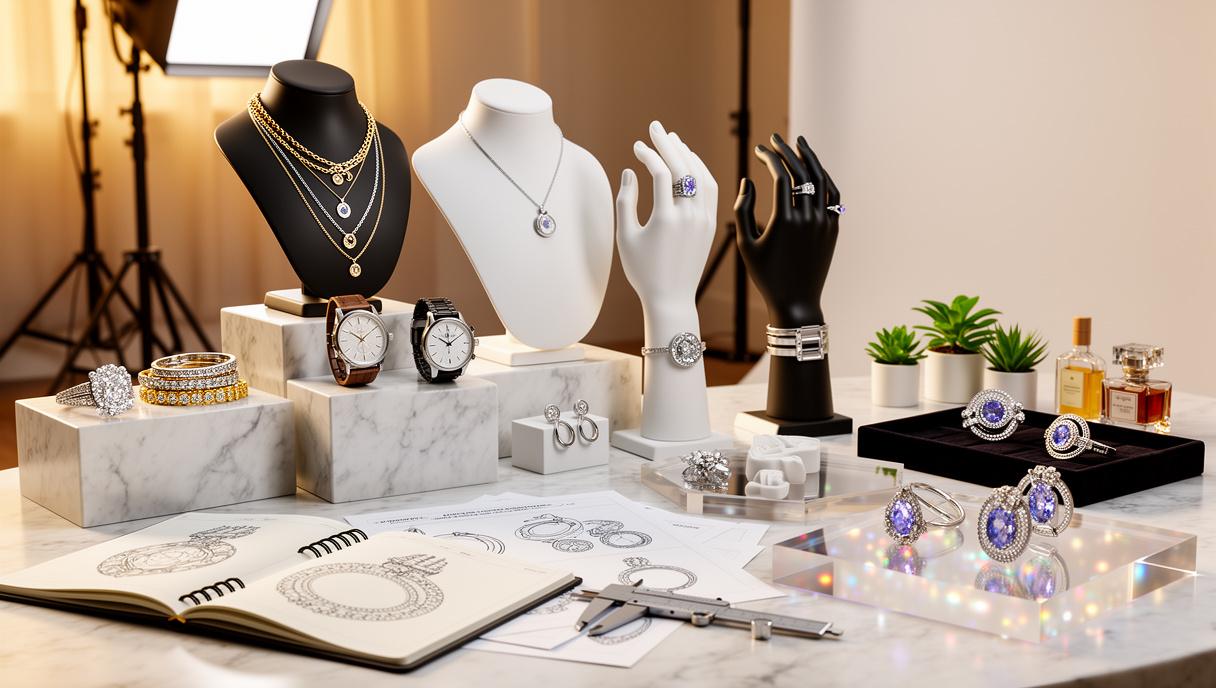
Core Capabilities That Elevate Jewellery Visuals From Good to Exceptional
Not all platforms are created equal. A purpose-built jewellery content creation tool goes beyond generic image editing by modeling how metals, stones, and mixed materials behave under light. Look for capabilities that support the entire content lifecycle—from concept to launch-ready assets—while locking in accuracy, brand control, and speed.
First, start with inputs. Designers and artisans should be able to import sketches, CAD files, or product photos. The system should translate CAD geometry into photoreal materials and render-ready models while interpreting prong settings, micro-details, and facet counts with fidelity. When working from photos, smart background removal and edge-aware masking are key to preserving fine elements like openwork filigree or delicate chains.
Next, consider the studio experience. Drag-and-drop staging lets you place pieces on neutral plinths, mirrored surfaces, or fabric textures, all tuned to luxury-grade lighting. Preset lighting rigs—softbox, rim light, and high-key or low-key setups—should be available alongside custom controls for highlights and reflections. For on-model imagery, a robust tool will enable realistic placement, scale, and depth-of-field, ensuring rings hug knuckles correctly, earrings hang naturally, and necklaces follow neckline contours without uncanny artifacts.
Accuracy drives trust. Gem color and dispersion must hold across outputs, especially for colored stones and fancy shapes. Look for calibrated color management, true-to-life metal shaders (platinum, rose gold, white gold, titanium), and physically based rendering that respects micro-scratches, satin finishes, and brushed textures. Realistic shadows, contact reflections, and soft bounce light enhance dimensionality and make small pieces feel tangible on any screen size.
Scalability is where value compounds. Template-driven scenes let you generate consistent packshots for entire collections at once—matching angles, crop ratios, and lighting. Lifestyle campaigns can be versioned for different regions, swapping backgrounds and props while keeping the hero piece and brand aesthetic intact. AI-assisted retouching accelerates dust removal, polish corrections, and alignment fixes, while batch exports in 2K and 4K ensure you have assets for PDPs, marketplaces, print inserts, and out-of-home needs.
Finally, collaboration and compliance matter in luxury workflows. Role-based approvals protect brand integrity and reduce misfires. Teams can annotate scenes, A/B test compositions, and track variants across channels. When you need to guarantee consistency for retail partners or franchise locations, reusable presets and shared libraries keep every asset on-brand. When a platform delivers these capabilities in one place, it becomes more than a helpful app—it becomes a production engine for jewellery and watch visuals.
Workflows, Use Cases, and Real-World Scenarios for Faster, Better Launches
Consider a boutique designer refining a new ring. Using CAD inputs, the studio generates photoreal metals and stones, then previews three shank thicknesses and two claw styles. Marketing prebuilds PDP packshots and a hero lifestyle scene against a marble surface with soft morning light. With on-model renders, sizing and proportion are checked on different hand sizes and skin tones. The collection goes from concept to a cohesive asset suite in days, not weeks, supporting pre-orders and gathering feedback before final tooling.
For a growing DTC brand, speed across channels is essential. The team creates clean white-background packshots for marketplaces, editorial images for the homepage, and vertical Stories showcasing stacking combinations. A single scene template enforces angle consistency for earrings and bracelets, while automatic shadow and reflection controls add depth. Color-accurate gold and gemstone rendering minimizes the gap between screen and reality, reducing returns driven by mismatched expectations.
Local marketing teams benefit from flexible storytelling. A London boutique can place the same pendant in a rainy-urban window scene while a Dubai partner chooses warm, sunlit interiors. Both preserve the brand’s lighting ratio and color profile. Seasonal moments—Valentine’s Day, Eid, Diwali, Christmas—can be turned into quick thematic variations by swapping props and palettes. Because assets export at 2K for mobile and 4K for print, the same core scenes support window displays, shoppable ads, and editorial placements.
Watch brands and high-end accessories have similar needs. Brushed finishes, sapphire crystals, and ceramic bezels demand physically accurate reflections and micro-contrast. Macro-style render setups highlight knurling and guilloché, while lifestyle scenes emphasize craftsmanship and heritage. With batch generation, a line of straps or dial colors can be launched simultaneously, each with consistent angles and lighting for clean comparison on product pages—a must for conversion-focused UX.
Operationally, the advantages compound. Instead of coordinating studios, models, stylists, and post-production across multiple cities, teams use a virtual studio to iterate quickly and maintain creative momentum. Costs shift from unpredictable shoot expenses to predictable platform time. Sustainability gains follow: fewer prototypes shipped, fewer reshoots, and less waste. When a retailer requests updated imagery for a seasonal push, assets can be refreshed in hours, not scheduled weeks out.
If you are exploring an upgrade to your production stack, look for a Jewellery content creation tool that supports concept-to-reality workflows, precise material science, on-model realism, and multi-output publishing. The ability to ingest sketches or CAD, generate true-to-life packshots, build lifestyle and on-model campaigns, and export 2K/4K files gives artisans, designers, and luxury teams the control they need to scale content without sacrificing quality. With these capabilities in place, every launch benefits from cohesive storytelling, regional adaptability, and the high-polish finish customers expect from premium jewellery.

Oslo marine-biologist turned Cape Town surf-science writer. Ingrid decodes wave dynamics, deep-sea mining debates, and Scandinavian minimalism hacks. She shapes her own surfboards from algae foam and forages seaweed for miso soup.